Stylish lighting, festive savings  12% discount on smoked glass lamps
Code: XMAS25
See the deals
info

LEDs can Ensure Better Growth for Plants

 
x-com
pinterest
whatsapp
mail-arrow
LEDs can Ensure Better Growth for Plants
 

LEDs are currently the most powerful light source. They emit bright light in any colour with pinpoint accuracy, are energy-saving and highly efficient. But LEDs can do much more than just provide brightness. The light from LEDs also has a positive effect on the growth of plants. With LED lighting, houseplants can grow better and more beautifully.

The growth and quality of vegetables, which otherwise thrive rather sparsely in greenhouses, can also be increased with LED light. Dutch scientists have now found out that lighting with LEDs can double the vitamin C content of tomatoes. In the following article we inform you about the research results of the Dutch scientists and explain how you can help your houseplants to grow better with the help of LED lamps.

  • LED lighting boosts plant growth and can double the vitamin C content of greenhouse tomatoes.
  • Plants use the violet-blue and orange-red light spectrum for photosynthesis.
  • LED lamps are characterised by high luminous efficacy, long life and low heat generation.
  • With LED lighting, plants thrive faster and more evenly.
Appropriate LED Light Increases the Vitamin C Content of Plants

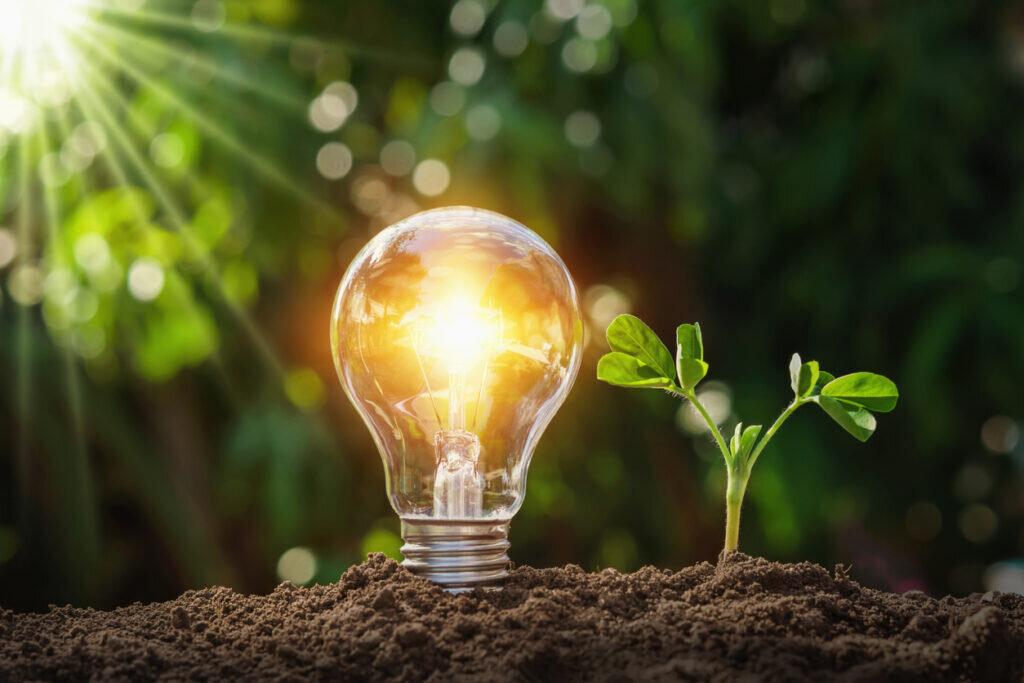
Tomatoes grown in greenhouses often do not get enough sunlight. As a result, they do not grow as well and a large part of the harvest has to be discarded. Scientists at Wageningen University in the Netherlands have now studied the effect of LED light on greenhouse plants. They exposed tomatoes in greenhouses with light from LED lamps in addition to natural sunlight. This not only led to better growth, the vitamin C content of the exposed tomatoes increased twofold. The researchers used special LED lamps from Philips for the exposure.

The tomatoes were provided with an extra dose of light equivalent to about a quarter of the light intensity of a sunny day. The extra lighting allowed fruits that otherwise had to thrive in the shade of leaves to grow better and ripen faster. So in the future, the researchers' findings could help reduce tomato rejects at harvest and at the same time increase the quality of the fruit.

Artificial Lighting for Houseplants

Every plant needs light to grow. As a rule, plants thrive best under natural sunlight. However, this is often not available in sufficient quantities. Additional artificial lighting can then help to enhance the growth and quality of plants. However, not all light produces the desired effects. Only certain spectral ranges of light, namely the violet-blue and the orange-red spectral ranges, can be used by plants for photosynthesis.

Photosynthesis, in turn, is crucial for the growth of the plant. In this process, the plant uses the supplied light energy to produce glucose and oxygen from water and carbon dioxide gas (CO2), which it in turn urgently needs for healthy growth and flower formation. Light requirements can vary greatly depending on the plant species. However, many plants need a lot of light, namely about 16 hours of light per day. Especially in winter, natural daylight is not enough.

How You can Increase the Growth of Houseplants with LEDs

Plants cannot thrive well when there is a lack of light. Many plants then develop long shoots, the leaves turn light green, later yellow or brown and finally fall off. With suitable LED lighting, you can give your houseplants exactly the light they need for healthy growth. However, the differences in the light spectrum of different light-emitting diodes can be great. Special LEDs for plant growth provide exactly the light spectrum and illuminance needed for photosynthesis.

Because LEDs generate little heat, they can be placed in close proximity to plants without harming them. In addition, LEDs have a very good energy efficiency: they can thus remain switched on for longer periods of time and, due to their long service life, the lamps do not need to be replaced so often. For your plants, the extra LED light means healthier growth, faster flowering and better quality.

Popular Articles

Latest Articles