The beam angle, often referred to as the angle of radiation, describes the angle at which a lamp emits light into a room. Understanding how different angles affect brightness and atmosphere allows you to tailor your lighting perfectly: from cosy general lighting to targeted lighting accents.

What is a beam angle?
The beam angle indicates how wide or narrow the light from a lamp spreads into the room. It is expressed in degrees and describes the opening angle of the light cone emitted by the lamp. In LED lamps, this angle can be precisely controlled using reflectors or lenses.
Typical beam angles at a glance
There are standard classifications for beam angles in lamps and luminaires:
- Spotlight (≤ 20°): highly concentrated, directional light – ideal for accent lighting.
- Flood (21–40°): medium angle – for zone and accent lighting.
- Wide Flood (41–60°): wide illumination of smaller areas.
- Extra Wide Flood (> 60°): large-area general lighting.
The beam angle of LED bulbs – what is it used for?
The beam angle is crucial when planning how a room or an object should be lit and is therefore a key criterion when choosing LED bulbs. It determines not only how bright an area appears, but also the mood and function the lighting fulfils:
-
For general lighting, wide beam angles of up to 120° are suitable to illuminate the room evenly and without large shadows.
-
For zone and path lighting, medium beam angles between 30° and 60° are optimal. This ensures that hallways, work areas or kitchen islands are clearly visible and pleasantly lit.
-
For accent lighting, small beam angles of around 15° to 25° are sufficient. This allows pictures, display cabinets or special pieces of furniture to be highlighted in a targeted manner.
-
Small beam angles are also useful for task and reading lights to create a concentrated, glare-free light that illuminates only the desired area.
-
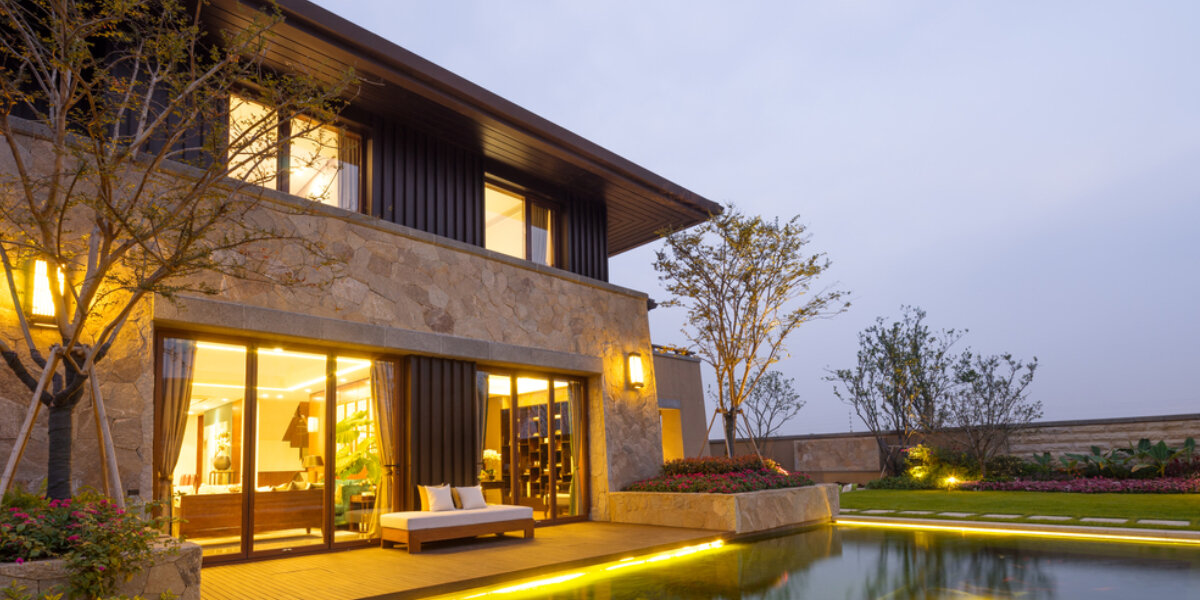
In outdoor lighting, the choice depends on the purpose: wide-beam spotlights are ideal for illuminating large areas such as gardens or terraces, whilst narrow beam angles allow for targeted effects on façades or objects.
Modern LED light bulbs, using reflectors and lenses, allow for flexible beam angles between 15° and 120°.
Calculating the beam angle
The size of the illuminated area depends on both the beam angle and the distance between the lamp and the object. The basic formula is:
Diameter of the illuminated area = 2 × distance × tan(beam angle ÷ 2)
This means: the larger the angle or the greater the distance, the larger the illuminated area becomes.
Examples at a distance of 2 metres:
| 15° beam angle: | approx. 0.5–0.6 m Ø → area approx. 60 × 60 cm |
| 30° beam angle: | approx. 1.1 m Ø → area approx. 1.1 × 1.1 m |
| 60° beam angle: | approx. 2 m Ø → area approx. 2 × 2 m |
| 90° beam angle: | approx. 3.5 m Ø → area approx. 3.5 × 3.5 m |
| 120° beam angle: | approx. 6.9 m Ø → area approx. 7 × 7 m |
The relationship between beam angle, lumens, lux and candela
To correctly assess the lighting effect of a lamp, the beam angle is crucial, as it determines how the light is distributed throughout the room. However, these terms are also important in relation to the beam angle:
- Lumen (lm) refers to the total amount of light emitted by a light source.
This value remains the same – regardless of whether the lamp has a narrow or wide beam angle. - Candela (cd) indicates the luminous intensity, i.e. how much of the total light output is directed into a specific direction. For the same lumen output, a narrow beam angle results in a higher candela value, as the light is more concentrated.
- Lux (lx) is the physical unit for illuminance on a surface (lumens per m²). The smaller the beam angle and the shorter the distance, the higher the lux value on the illuminated surface.
Conclusion: The beam angle is a crucial factor when choosing lamps and luminaires. It determines not only the illuminated area but also how bright the light appears at the desired location. Even small differences in beam angle can significantly alter the illuminated area. Narrow angles are sufficient for targeted spot lighting, whilst wide angles are necessary for uniform general lighting.